Building a Technology Roadmap for a Construction Business
Construction businesses face a sequencing problem with an extra complication: there is never a quiet period. Projects are always running, deadlines are always pressing, and the cost of pausing to reorganise is felt immediately in lost progress and delayed handovers.
So technology work happens in fragments — a security fix here, a new tool there, a project structure invented from scratch each time. Nothing is wrong with any individual decision, but the business never builds momentum because each step starts from a different baseline.
A roadmap is not a document. It is a sequence: an agreed order that lets the business do the right things in the right order, while projects continue to run.
The short answer
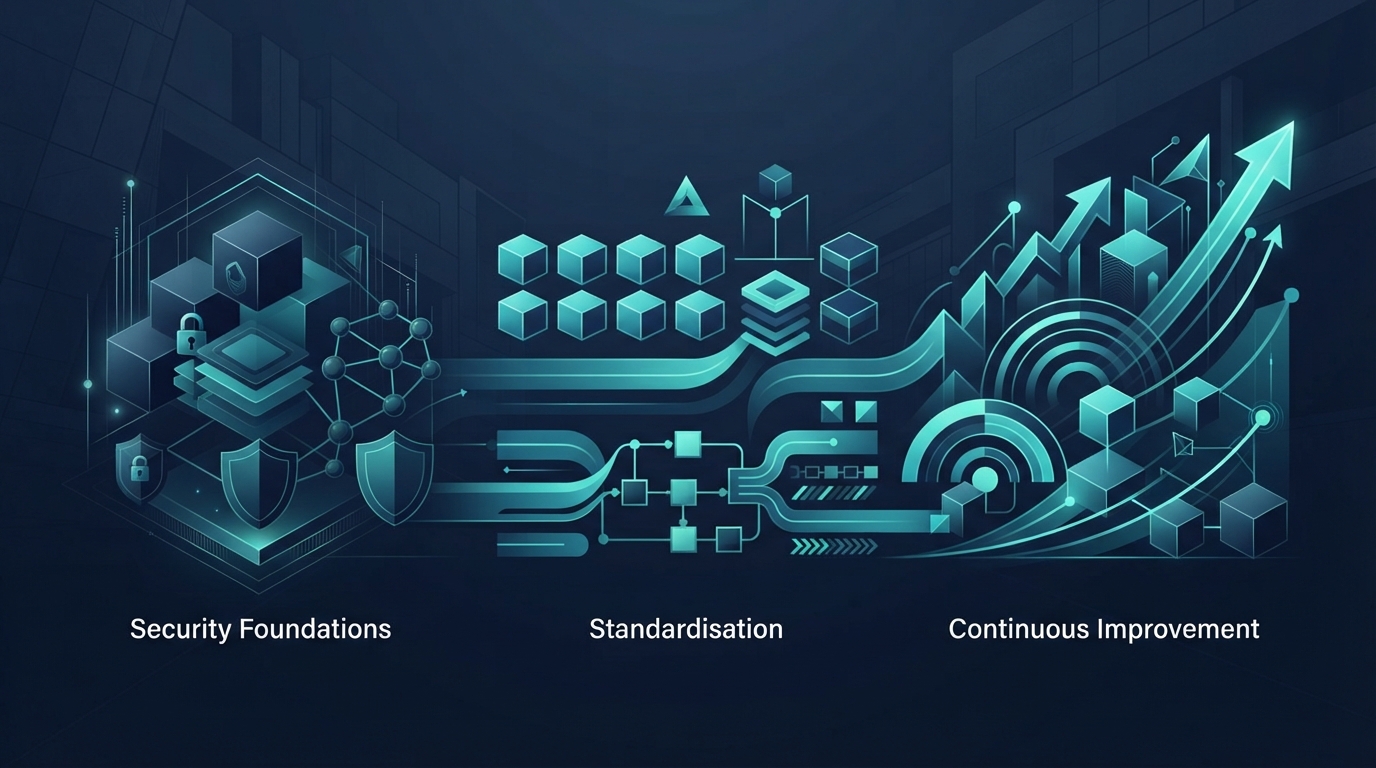
Secure and understand what you have before you standardise; standardise before you automate; automate before you introduce AI. That sequence — the LOOKUP Business Modernisation Framework — works because each stage makes the next one possible. Reversing it is the most common reason technology investment in construction fails to deliver: automating disorganised information multiplies errors, and adopting AI before permissions are under control exposes the business to risk it did not have before.
Why sequence matters more than selection
Most construction businesses do not fail because they chose the wrong tool. They struggle because they did the right things in the wrong order, and the order is what determines whether each investment builds on the last or competes with it.
Automating before information is consistent means the automation runs on whatever happens to be in each system — which may be wrong, duplicated or out of date. The result is faster errors, not fewer.
Adopting AI before permissions are controlled means AI reaches whatever the person using it can already see — which, in a construction business, often includes tender pricing, commercial terms and external parties' documents. The risk is not theoretical; it is the single most common reason AI goes wrong in a small business.
Building project information structures before deciding what the standard structure is means every project invents its own. A structure that is different on every project cannot be learned by the people who move between them, and it cannot be automated because there is nothing consistent to automate.
The sequence is not a suggestion. It is the difference between technology that compounds and technology that stalls.
The LOOKUP Business Modernisation Framework™
Building a technology roadmap for a construction business follows the same eight-stage sequence every LOOKUP engagement uses — because the order is what makes the investment stick.
Understand the current environment
Protect identities, devices and information
Remove legacy technology constraints
Create consistent systems and processes
Improve workflows and productivity
Establish governance and AI readiness
Introduce technology deliberately
Measure, review and continuously improve
Understand the current environment
Protect identities, devices and information
Remove legacy technology constraints
Create consistent systems and processes
Improve workflows and productivity
Establish governance and AI readiness
Introduce technology deliberately
Measure, review and continuously improve
Discover
Map current systems across every project — estimating, project management, accounting, Microsoft 365, email and site access — to understand what exists before changing anything.
Secure
Protect identities, email and devices first. Multi-factor authentication, conditional access and email protection close the gaps that invoice fraud and payment redirection exploit.
Modernise
Remove legacy constraints — old devices, unsupported software and manual processes — so the business is not building on foundations that will not hold.
Standardise
Define one project information structure, one set of permission groups and one device build. Every project, including the next one, starts from the same template.
Optimise
Connect the systems that already exist — estimating to project management, project management to accounting — to remove the duplicate entry that consumes hours and introduces errors.
Prepare
Establish governance and AI readiness: permissions that reflect who should see what, approved tools, and a clear line on what is never pasted into a public AI tool.
Implement
Introduce AI and automation one workflow at a time, with a named owner and a measured result, before anything is scaled across the portfolio.
Improve
Review what worked, what did not and what changed. A roadmap is a living document, not a one-off plan — it should be revisited as projects start and finish.
Working around live projects
Construction has no natural pause. Projects are always running, deadlines are always pressing, and the cost of stopping to reorganise is felt immediately in lost progress and delayed handovers. So the roadmap has to assume work continues throughout.
The practical approach is to introduce change on the next project rather than impose it on one already running. A project that is mid-flight has its own momentum, its own commitments and its own information structure. Forcing a new standard onto it risks disrupting something that is working, however imperfectly.
Instead, the standard is proven once — on a single new project, from setup through to handover — and then replicated. The first project is the proof. It shows what works, what needs adjusting and where the gaps are. Once it has been delivered, every subsequent project starts from that template rather than inventing its own.
This is slower in theory but faster in practice. A standard that is forced onto reluctant projects tends to be abandoned. One that is proven on a live project and then offered as the starting point for the next tends to hold.
The same principle applies to security changes, Microsoft 365 configuration and device standards. They are introduced office by office or team by team, not in a single cutover that disrupts everyone at once.
What comes first for most construction businesses
Identity, access and email protection almost always precede everything else. The reason is not abstract: construction businesses are specifically targeted by invoice fraud and payment redirection, and those attacks succeed through compromised or impersonated email. Multi-factor authentication, conditional access and email protection are the controls that close that gap. Nothing else on the roadmap matters if the accounts are open.
After security, project information structure comes next. Everything later in the sequence — automation, AI, reporting — depends on information being in a consistent, known place. If the current revision of a drawing is unclear to a person, it will be unclear to every system that touches it. Defining one project information structure, one set of permissions and one naming convention is not glamorous work, but it is the foundation everything else sits on.
Device standards come alongside or shortly after. A construction business with a mix of personal laptops, unsupported software and unmanaged mobile devices cannot secure its information reliably. Standardising the device build — what is installed, how it is configured, how it is protected — closes that gap before it becomes a problem on the next project.
The order is not rigid. A business with an acute security incident may need to move email and identity protection forward, even if information structure is still messy. But the general principle holds: secure first, then make information consistent, then build on top of it.
How to tell which stage you are actually at
The question is not where you want to be. It is where you are right now — because the next step depends on it. These diagnostic questions can be answered by a director without a consultant, from the business's own experience.
Can you say, with confidence, who has access to what?
If the answer is no — if you cannot produce a list of who can open which project folder, who has guest access, or which departed staff still have active accounts — you are still in the Secure stage. Identity and access control come before anything else.
Does every project start from the same information structure?
If each project invents its own folder structure, naming convention and permission groups, you have not yet reached Standardise. The information is being organised, but differently each time, which means it cannot be learned, automated or reliably handed over.
Is the same information being typed into more than one system?
If scope, variations, purchase orders or progress claims are re-entered between estimating, project management and accounting, you are in the early stages of Optimise. The systems exist but the joins between them do not, and the duplicate entry is consuming time and introducing errors.
Have you decided which AI tools staff are allowed to use?
If staff are pasting project information into public AI tools without a policy, you have not reached Prepare. Governance — a clear, enforceable position on approved tools and what is never pasted into them — comes before AI is introduced into project workflows.
Has any AI workflow been proven with a named owner and a measured result?
If the answer is no, you have not reached Implement. AI is being used informally, perhaps individually, but it has not been introduced as a managed workflow with an owner, a defined scope and a review point.
What a roadmap should contain
A roadmap is not a wish list. It is a document that lets the business make decisions in the right order, with enough specificity that someone can actually start. If it does not contain these five things, it is a description, not a plan.
A current position
An honest assessment of where the business is now — what systems exist, what is secured, what is not, what is duplicated and what is missing. Without a current position, the sequence is guesswork.
A sequence with reasons
Not just what comes next, but why. The reason matters because circumstances change, and when they do, the business needs to know which parts of the sequence are fixed and which can flex. A sequence without reasons cannot be adjusted intelligently.
A first step small enough to start
A roadmap that begins with a multi-month programme will not begin. The first step should be concrete, bounded and completable — something like turning on multi-factor authentication for all accounts, or defining the project folder structure for the next job. Small enough that it actually happens.
Named owners
Each step has a person responsible for it — not a department, not a role, a person. A roadmap without owners is a document nobody is accountable for. The owner does not have to do the work themselves, but they are the one who answers for whether it happened.
A review point
A specific date or milestone when the roadmap is revisited — what was completed, what was not, what changed and what comes next. A roadmap that is never reviewed is a document that was written once and then quietly ignored. The review point is what keeps it alive.
A roadmap nobody owns is a document, not a plan. The difference is whether someone is accountable for making the next step happen.
How LOOKUP helps
LOOKUP works alongside construction businesses at every stage of the roadmap, from understanding the current position through to delivering staged improvements that fit around live projects. We coordinate with estimating, project management and accounting platforms rather than replacing them — the goal is to connect what already works, not start over.
Discovery and assessment
Before any recommendation, LOOKUP assesses the current technology environment — systems, security, devices, information structure and the joins between them. The assessment identifies where the business actually sits in the sequence, which gaps matter most and what should come first. This is the construction and property development context applied to your specific business, not a generic IT audit.
Roadmap development
From the assessment, LOOKUP develops a roadmap that names the sequence, the reasons behind it, the first step and the owners. The roadmap is built around the reality that projects are running — change is introduced on the next project, not imposed mid-flight. Where senior technology leadership is needed without a full-time hire, LOOKUP's Virtual CIO service can own the roadmap and keep it accountable.
Staged delivery
Delivery happens in stages that fit around the business, not in a single cutover. Security controls go first, then information structure, then automation and AI — each proven before it is replicated. LOOKUP coordinates with the specialist platforms the business already uses, ensuring the surrounding Microsoft 365 environment, identity, devices and support are consistent and secure without disrupting the tools project teams rely on.
The other outcomes in this series
This page is one of six business outcomes for construction and property development. Each addresses a distinct question a director or project leader may be asking.
Improving Project Information and Document Control
Is everyone on site building from the current drawing? How to get one authoritative version of project information and make it reachable from site.
Securing External Collaboration and Project Access
Consultants, subcontractors and clients all need access. How to grant it properly and take it back when the project ends.
Preventing Invoice and Payment-Redirection Fraud
Construction is specifically targeted by invoice fraud. How to stop a fraudulent payment instruction being acted on.
Reducing Administrative Overhead
Why is the same information typed into estimating, project management and accounting three times, and what can be done about it.
Preparing a Construction Business for AI
Where can AI genuinely help a project business, what must be true first, and which decisions must never leave a qualified person.
Frequently asked questions
A technology roadmap is a sequenced plan that names what to do, in what order, and why. For a construction business it accounts for the reality that projects are always running, so change is introduced on the next project rather than imposed mid-flight. It is not a shopping list — it is a sequence of decisions with owners and review points.
Doing the right things in the wrong order wastes effort and can create new risk. Automating before information is consistent multiplies errors. Adopting AI before permissions are controlled exposes commercial information. The sequence exists because each stage depends on the one before it.
Identity, access and email protection almost always come first, because everything later depends on them and because the payment fraud exposure is real. After that, project information structure is usually next, because automation and AI both depend on information being in a known, consistent place.
Change is introduced on the next project, not imposed on one already running. The standard is proven once — in a single project or office — before it is replicated. This keeps the business operating while the technology improves around it.
Usually not. The roadmap connects existing systems rather than replacing them. LOOKUP coordinates with estimating, project management and accounting platforms and improves the surrounding Microsoft 365, identity and security environment. Replacement is a last resort, not a starting point.
It depends on the scope of the business, the number of projects running, the current state of systems and the people available. A roadmap is not a single project with a fixed end date — it is a sequence of stages, each with its own owner and review point. Some stages take weeks, others run alongside the business for months.
It is an eight-stage methodology — Discover, Secure, Modernise, Standardise, Optimise, Prepare, Implement, Improve — that sequences technology decisions in the right order. It is the structure behind every roadmap LOOKUP builds, so the business does not have to work out the sequence from scratch.
You can, but it usually underdelivers or creates risk. AI reaches whatever the person using it can already reach, so if permissions are loose or project information is inconsistent, AI surfaces or amplifies those problems. The earlier stages are the preparation that makes AI useful rather than dangerous.
Ask yourself a few honest questions: can you confirm every account has multi-factor authentication? Can a new starter or a subcontractor be given the right access in hours, not days? Does everyone on site know which drawing is current? If the answers are uncertain, the business is earlier in the sequence than it may assume.
Secure comes before standardise in the framework, because standardising on top of an insecure foundation just makes the risk consistent across every project. Close the identity, email and device gaps first, then define the standard structure those controls protect.
Automating inconsistent information multiplies the inconsistency — the same error appears in every connected system instead of just one. The information has to be in a known, consistent place with a clear owner before automation can move it reliably.
A named person — not a department or a role. In a construction business that is often a director, a general manager or a senior project leader. Where the business does not have a full-time technology leader, a Virtual CIO can own the roadmap and keep it accountable.
The roadmap is built around the portfolio, not a single project. Standards are introduced on the next project starting, not retroactively on live ones. As each new project begins it picks up the current standard, so the portfolio migrates naturally as work turns over.
A current position, a sequence with reasons, a first step small enough to actually start, named owners for each stage, and a review point. A roadmap without those five elements is a wish list. A roadmap nobody owns is a document, not a plan.
At a defined point — not when someone remembers. A common approach is to review at major project milestones, quarterly, or when a new project or office is about to start. The review checks what was completed, what was not, what changed and what comes next.
Sources & Further Reading
The following primary and authoritative sources support the research, guidance and industry context discussed on this page:
Essential Eight — Australian Signals Directorate's Australian Cyber Security Centre
The baseline mitigation strategies that sit behind the Secure stage of the framework.
View SourceGuidance for AI Adoption — National AI Centre, Department of Industry, Science and Resources
Six essential practices for governing and adopting AI responsibly, relevant to the Prepare and Implement stages.
View SourceEvidence Standard
LOOKUP references recognised industry, government, professional and technology sources when discussing research, regulation and industry trends. Research findings are paraphrased and linked to their original sources wherever practical. LOOKUP's professional observations and recommendations are presented separately from third-party research.
Ready to sequence your technology investment?
A roadmap turns a list of urgent technology decisions into an ordered plan the business can actually execute. Book a strategy session to map your current position, define the sequence and identify the first step.
Peter Kantarelis
Founder, LOOKUP — Business Technology Strategist
Peter Kantarelis is the Founder of LOOKUP and a business technology strategist helping Australian organisations modernise technology, strengthen cyber security and prepare for practical AI adoption. He regularly works with business owners and leadership teams to improve productivity, reduce operational risk and implement technology that delivers measurable business outcomes. The LOOKUP Business Modernisation Framework™ reflects more than 25 years of helping Australian businesses make better technology decisions.
View More Insights