Reducing Administrative Overhead in an HVAC Business
Administrative overhead is usually a process problem before it is an automation or AI problem. LOOKUP helps HVAC and mechanical services businesses understand their workflows, standardise processes, reduce duplicate handling and apply automation and AI where they genuinely add value.
The short answer
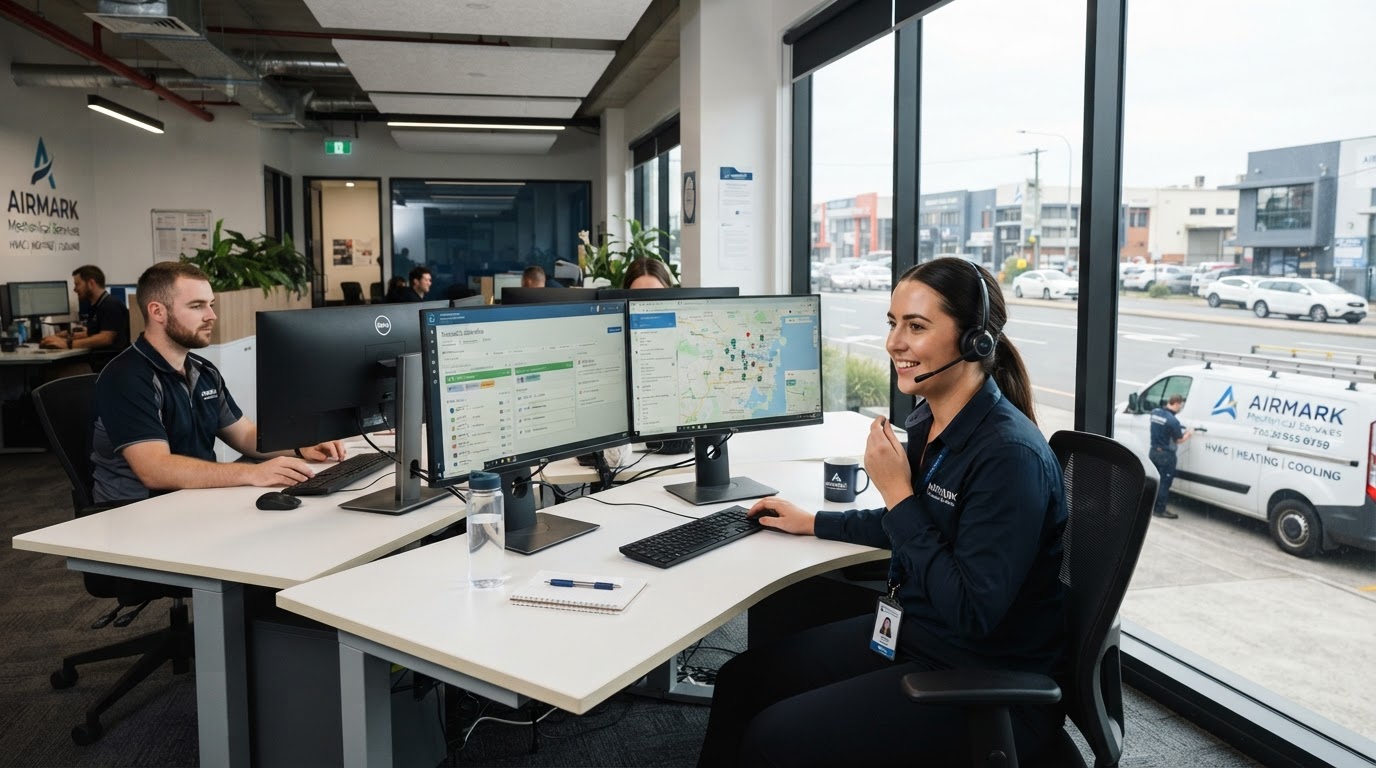
How can an HVAC business reduce administrative overhead? Start by understanding where time is being consumed across the business — repeated data entry, phone and email handoffs, job creation, scheduling communication, customer follow-up, quote follow-up, purchase and order administration, technician paperwork, photos and document handling, completion administration, invoice preparation, internal approvals and reporting. Structuring job, asset and service information reduces much of this friction at the source.
Once the friction points are mapped, determine whether each problem should be eliminated, standardised, simplified, integrated, automated or AI-assisted. The objective is not simply fewer administrative tasks — it is more productive capacity for customer service and technical work.
Technology helps, but automation should follow process understanding. Do not automate a broken process simply because automation technology exists.
Where HVAC administration accumulates
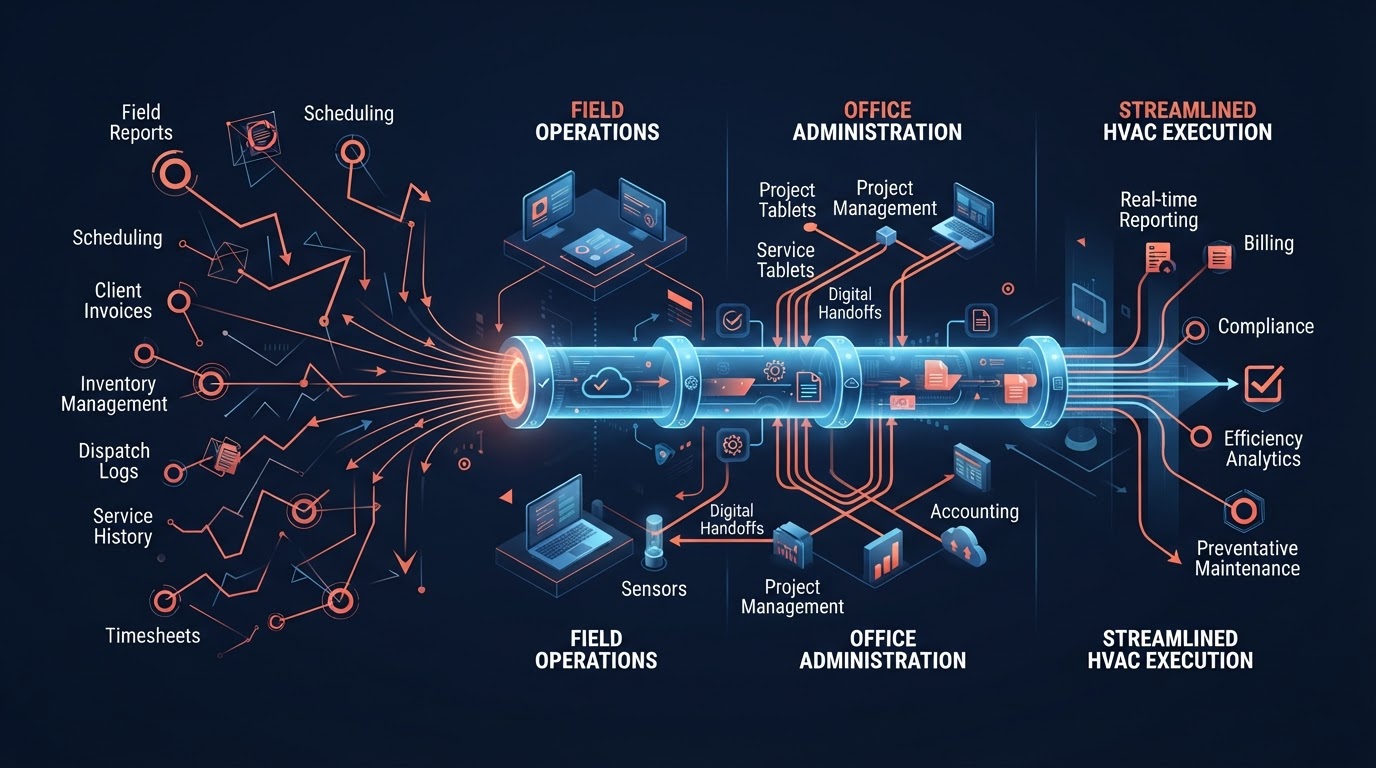
Administrative overhead in HVAC and mechanical services businesses usually accumulates at the handoffs — between office and field, between customer enquiry and job creation, between technician completion and invoice readiness. These are process and system causes, not individual employee problems.
Information passed verbally or by email between office and field.
The same customer, job or site information keyed into multiple systems.
Multiple calls or messages to confirm availability and dispatch.
Manual reminders for quotes, appointments and service due dates.
Job notes, photos and completion details arriving in inconsistent formats.
Manual review and re-entry before an invoice can be prepared.
Map the process before automating it
The most common mistake is automating a process that has not been understood. If a workflow includes unnecessary steps, inconsistent handoffs or duplicated effort, automation will simply make the inefficiency faster.
Do not automate unnecessary complexity. Remove unnecessary steps first, agree on a standard approach, then determine where automation or AI adds genuine value.
Technology rationalisation can be as important as technology acquisition. Another application can sometimes create additional administration rather than reducing it.
Customer enquiry and job creation
The enquiry-to-job workflow is one of the most common sources of administrative friction. Information is captured inconsistently — sometimes by phone, sometimes by email, sometimes by form — and then re-keyed into a job management system.
A structured approach captures customer, site, issue, priority, contact and availability information consistently, creates the job automatically where appropriate, and sends an acknowledgement to the customer. Higher-risk, judgement-dependent or regulated activities should retain human review.
Technician-to-office handoffs
When technicians complete work, information often returns to the office through multiple channels — phone calls, text messages, emails, photos and paper notes. This creates information gaps, delays and re-entry.
Structured forms, automated notifications and photo routing can improve the flow of job notes, materials, asset details, completion status, follow-up work and customer approval information between field and office.
Technical content, compliance details and safety information should still be reviewed by appropriate staff.
Quote and follow-up administration
Quote preparation and follow-up is a common source of administrative friction. Quotes may be drafted manually, sent as attachments, and followed up through individual phone calls or emails — often with inconsistent timing.
Automated reminders, status notifications and task creation can reduce the manual effort of quote follow-up. Quote content, pricing and customer-specific terms should remain human-reviewed. For a deeper treatment of the quote-to-job workflow, see our Improving Quote-to-Job Workflow Business Outcome.
Completion and invoice readiness
The gap between technician completion and invoice readiness is a frequent source of administrative delay. Job notes arrive in inconsistent formats, materials need to be reconciled, and information must be reviewed before an invoice can be prepared.
Improving information flow between technician, job completion, office review and invoice-ready information reduces delays and rework. Structured completion forms, automated notifications and status tracking help ensure the right information is available at the right time.
This page provides business technology guidance and does not constitute accounting advice.
Where workflow automation can help
Workflow automation can reduce manual handoffs and repetitive tasks. Not every process should be automated — judgement-dependent, safety-critical or customer-specific decisions should retain human oversight.
Automated alerts when jobs are created, completed or delayed.
Structured approval workflows with audit trails.
Automatic task generation from enquiries or completions.
Follow-up reminders for quotes, appointments and service due dates.
Photos and documents routed to the right location automatically.
Information shared between systems where supported by APIs.
Where AI can help
AI can complement automation by assisting with tasks that involve information retrieval, drafting and summarisation. For a deeper treatment of AI readiness for HVAC businesses, see our Preparing an HVAC Business for AI Business Outcome.
Summarising long emails, manuals or meeting notes.
Drafting follow-ups, reminders and service notifications.
Finding information across documents and systems.
Categorising enquiries or documents automatically.
Drafting internal reports or standard communications.
Identifying tasks and follow-ups from correspondence or meetings.
AI-generated content should be reviewed by a human before it is sent to a customer or used in a business-critical context.
63% reduction in administrative work reported
Kiely Plumbing, a Tasmanian plumbing business, reported a 63% reduction in administrative work after implementing integrated field-service software. This is a named Australian field-service customer result published by Simpro — not an HVAC industry benchmark. See Simpro Customer Story: Kiely Plumbing.
Microsoft 365 and automation
Many HVAC businesses already own Microsoft 365, which includes tools that can support workflow automation: Power Automate for workflow creation, Forms for structured data capture, Teams for communication, SharePoint for document collaboration, Planner for task management and Power Apps for simple business applications.
According to official Microsoft documentation, Power Automate can create automated workflows between applications and services. Not all features are available in every licence — check your current licensing before planning deployment.
Microsoft 365 should complement, not replace, specialist field-service software. The right approach is to use the right system for the right job and focus on integration and workflow gaps.
Integrate field-service systems rather than recreate them
Specialist field-service software provides job management, scheduling, dispatch, asset tracking and customer management functionality that should not be rebuilt in Microsoft 365 simply because it is possible.
The better approach is to improve the workflow between systems — using APIs, approved connectors, Power Automate or structured notifications to reduce manual handoffs and duplicate data entry. Not every platform exposes suitable APIs, so integration feasibility should be assessed before committing to an approach.
What should an HVAC business automate first?
Assess each process against these criteria to identify the strongest automation candidates:
How often the process occurs.
How many instances occur in a period.
How consistent the process is each time.
The impact of reducing manual effort.
How often manual handling creates mistakes.
Whether automation improves customer experience.
How much human decision-making is involved.
How difficult it is to connect the systems.
The consequences of getting it wrong.
Prioritise high-frequency, repeatable, well-understood and low-judgement processes before complex professional decision-making.
How this maps to the LOOKUP Business Modernisation Framework™
Reducing administrative overhead follows the same structured methodology that guides every LOOKUP engagement. Learn more about the Business Modernisation Framework™.
Map current administrative workflows, handoffs and information flows.
Ensure workflow changes protect customer and business information.
Address legacy systems and improve Microsoft 365 foundations.
Create consistent processes for job creation, handoffs and follow-up.
Remove unnecessary steps and reduce duplicate data entry.
Identify appropriate automation and AI opportunities.
Deploy automation and AI tools deliberately with training.
Measure administrative efficiency and continuously refine.
What success looks like
Successful administrative modernisation is measured by business outcomes, not by the number of automations deployed.
Reduced re-keying of information across systems.
Information flows between field and office more smoothly.
Clearer status tracking from enquiry to completion.
Standardised workflows across the business.
Reduced delays between technician completion and office action.
Less time spent on repetitive manual tasks.
Staff focus on customers, not administration.
Research and industry insights
Microsoft's Power Automate documentation provides official guidance on workflow automation capabilities within Microsoft 365, including how automated workflows can reduce manual handoffs between applications.
The Australian Cyber Security Centre provides guidance on baseline security controls relevant to protecting customer information in automated workflows, including identity protection and access control.
Microsoft's 2024 Work Trend Index examined how AI-assisted activities such as drafting, summarising and information retrieval can affect the way knowledge workers perform administrative and information-heavy tasks. This research is relevant to HVAC businesses considering AI for office and administrative functions.
The Australian Government's voluntary AI Ethics Framework provides principles for responsible AI adoption, including fairness, transparency, accountability and privacy — relevant to any Australian business exploring AI for administrative workflows.
What this could look like in practice
For example, a growing HVAC and mechanical services contractor might have increasing service volume, an office team re-keying information between the field-service platform and Microsoft 365, technicians sending job details through multiple channels, and manual follow-ups for quotes and appointments. There is growing interest in AI but no agreed governance.
A structured approach might involve:
Frequently asked questions
How can an HVAC business reduce administration?
An HVAC business can reduce administration by mapping current workflows, identifying duplicate data entry and manual handoffs, standardising processes, and then applying automation or AI where it genuinely adds value. The objective is not to eliminate all administration but to create more capacity for customer service and technical work.
What HVAC office tasks can be automated?
Common candidates include job creation notifications, customer follow-up reminders, internal approvals, document routing, status updates and data synchronisation between systems. Not every task should be automated — processes involving judgement, safety or customer-specific decisions should retain human oversight.
Can AI reduce HVAC administration?
AI can help reduce repetitive administrative work such as drafting customer communications, summarising meeting notes, extracting actions from correspondence and searching for information. AI should support — not replace — human review of customer commitments and technical decisions.
Can customer enquiries create jobs automatically?
Customer enquiries can trigger automated job creation workflows using forms, notifications and task generation. However, triage decisions involving priority, safety, contractual commitments or complex requirements should involve human staff.
Can technician paperwork be automated?
Technician-to-office handoffs can be improved through structured forms, automated notifications, photo routing and completion workflows. This reduces information gaps and manual re-entry. Technical content and compliance details should still be reviewed by appropriate staff.
Can Microsoft 365 automate HVAC workflows?
Microsoft 365 includes Power Automate, Forms, Teams, SharePoint and Planner — tools that can support workflow automation for notifications, approvals, task creation and document routing. Not all features are available in every licence. Microsoft 365 should complement, not replace, specialist field-service software.
What is Power Automate?
Power Automate is a Microsoft 365 tool that creates automated workflows between applications and services. It can send notifications, create tasks, route documents, synchronise data and trigger approvals without manual intervention. Availability depends on your Microsoft 365 licence.
Should HVAC businesses automate quote follow-up?
Quote follow-up is often a strong automation candidate because it is repetitive, time-sensitive and rules-based. Automated reminders, status notifications and task creation can help. Quote content, pricing and customer-specific terms should remain human-reviewed.
Can automation reduce duplicate data entry?
Yes. Where systems support integration through APIs or approved connectors, automation can synchronise data between platforms — reducing the need to re-key customer, job or invoice information. Not every system exposes suitable APIs, so integration feasibility should be assessed first.
Should field-service software be replaced?
Not necessarily. Specialist field-service software often provides job management, scheduling, dispatch and asset tracking functionality that should not be rebuilt in Microsoft 365. The better approach is to improve the workflow between systems and address integration gaps.
How do field and office systems integrate?
Integration may use APIs, approved connectors, Power Automate, workflow platforms or structured notifications. The right approach depends on the systems involved, the data being exchanged and the business requirements. Not every platform supports direct integration.
What should an HVAC business automate first?
Prioritise processes that are high-frequency, repeatable, well-understood and low-judgement. Customer follow-up reminders, job status notifications and internal task creation are common starting points. Complex, judgement-dependent or high-risk processes should be automated later.
Should processes be standardised first?
Yes. Standardising processes before automating them is a core principle. Automating an inconsistent or broken process creates faster inconsistency. Map the workflow, remove unnecessary steps, agree on a standard approach, then automate.
How do you measure administrative efficiency?
Measure outcomes such as time spent on a workflow, number of manual handoffs, client response time, process completion time, rework rates and staff experience. Do not measure success by the number of automations or AI licences deployed.
Where should an HVAC business start?
Start by mapping your highest-volume administrative workflows. Identify where duplicate entry, manual handoffs and repetitive follow-up consume the most time. Standardise those processes, review existing Microsoft 365 capabilities, then identify one or two automation opportunities to pilot.
What business leaders should do next
Related resources and services
Build the foundations for responsible AI adoption.
Structure operational information for better field work and AI readiness.
Bring administration, Microsoft 365, security and AI into one coordinated plan.
Industry-specific technology guidance.
Automate repetitive workflows.
Optimise your Microsoft 365 environment.
Deploy AI with governance and oversight.
Reliable technology support.
The eight-stage methodology.
Plan technology investment strategically.
Book a strategy session.
Sources & Further Reading
Official documentation on workflow automation capabilities within Microsoft 365.
View SourceGuidance on baseline cyber security controls relevant to workflow and automation security.
View SourceOfficial documentation on how Copilot works within Microsoft 365 permissions and environments.
View SourceGuidance on privacy obligations relevant to customer information in automated workflows.
View SourceResearch examining how AI-assisted activities affect knowledge worker productivity.
View SourceVoluntary framework providing ethical principles for responsible AI adoption.
View SourceLOOKUP references recognised industry, government, professional and technology sources when discussing research, regulation and industry trends. Research findings are paraphrased and linked to their original sources wherever practical. LOOKUP's professional observations and recommendations are presented separately from third-party research.
This page provides general business technology information. AI use should be assessed against the organisation's operational, safety, privacy, contractual and regulatory responsibilities.
Create More Capacity Without Adding More Complexity
LOOKUP helps HVAC and mechanical services businesses simplify workflows, improve Microsoft 365, implement practical automation and prepare for AI through business-first technology strategy. Explore our broader technology approach for HVAC & mechanical services businesses.