
Preparing an HVAC & Mechanical Services Business for AI
AI readiness starts with the business and information environment — not the AI product. LOOKUP helps HVAC and mechanical services businesses prepare the right workflows, information, security and governance foundations before implementing AI.
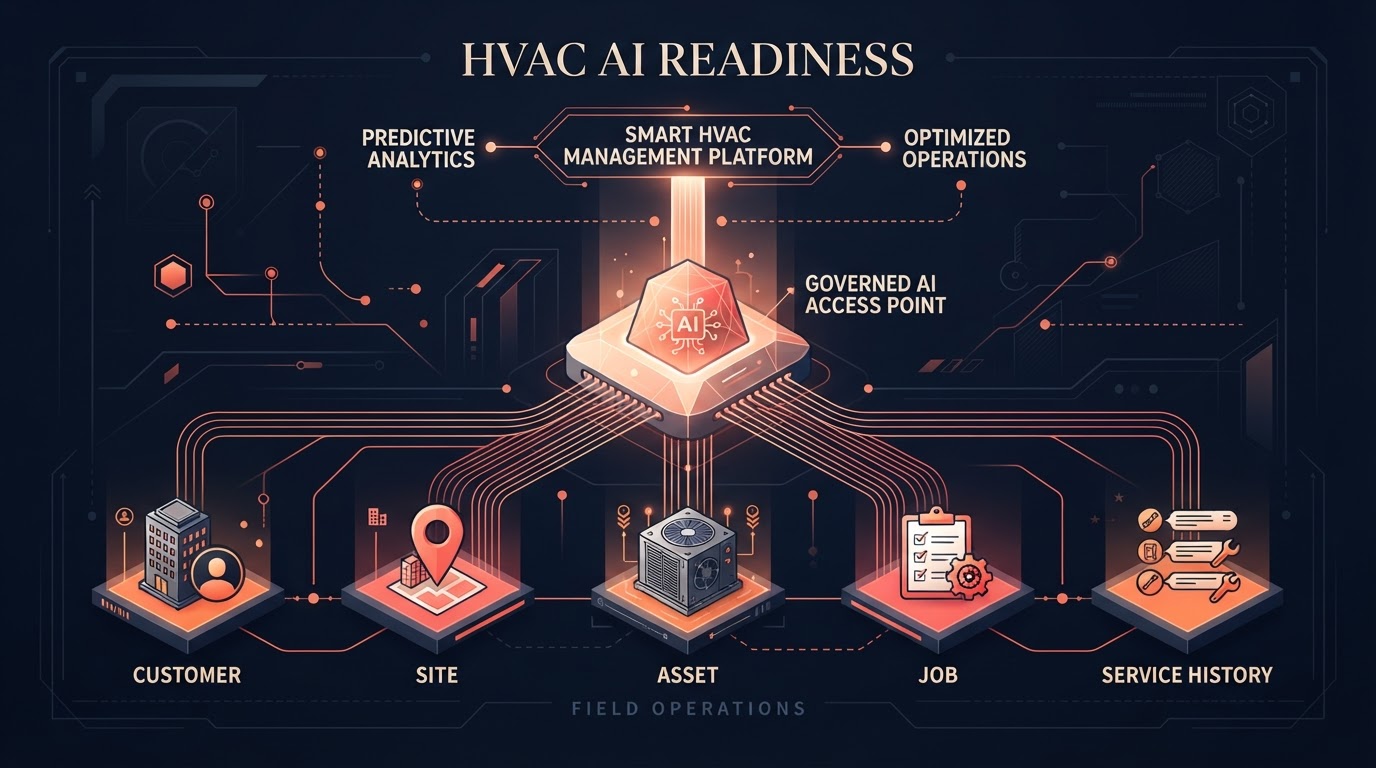
The short answer
How should an HVAC business prepare for AI? Start by understanding the current business environment before selecting AI tools. This means reviewing administrative workflows, scheduling and dispatch processes, quote-to-job processes, job and asset information, customer and site records, Microsoft 365 configuration, field-service systems, integrations, cyber security, data quality, permissions, governance and staff capability.
Once the business environment is understood, identify specific AI use cases where AI can genuinely assist — such as customer enquiry triage, scheduling support, quote drafting, meeting summaries or knowledge search. Then establish governance, approved tools and human review processes before deployment.
AI should never make technical, safety or compliance decisions autonomously. It should support human decision-makers, not replace them.
Where AI may help an HVAC business
AI can potentially assist with several activities common to HVAC and mechanical services businesses. Not every use case should be automated, and AI should support — not replace — professional judgement.
Drafting responses and triaging incoming requests.
Suggesting priority and technician assignment.
Supporting dispatch decisions with location and skills data.
Pulling job details into structured quote templates.
Summarising long emails, manuals or reports.
Capturing actions from internal discussions.
Drafting follow-ups and service reminders.
Finding information across documents and systems.
Helping field staff find manuals and service history.
Automating reminders and task creation.
Summarising operational data and exceptions.
Start with the workflow, not the AI product
The most common mistake is buying an AI tool before understanding the underlying workflow. A scheduling AI cannot help if the scheduling process itself is inconsistent or poorly understood.
Before introducing AI, map the workflow from enquiry through to dispatch:
Only once the workflow is understood can you determine where automation or AI adds genuine value — and where human judgement should remain.
Technology should follow process understanding. Buying an AI scheduling tool before understanding your scheduling workflow creates complexity, not efficiency.
Information quality determines AI usefulness
AI is only as useful as the information it can access. For HVAC businesses, this includes customer records, site records, asset and equipment information, service history, job notes, photos, manuals, quotes, invoices, emails and technician knowledge.
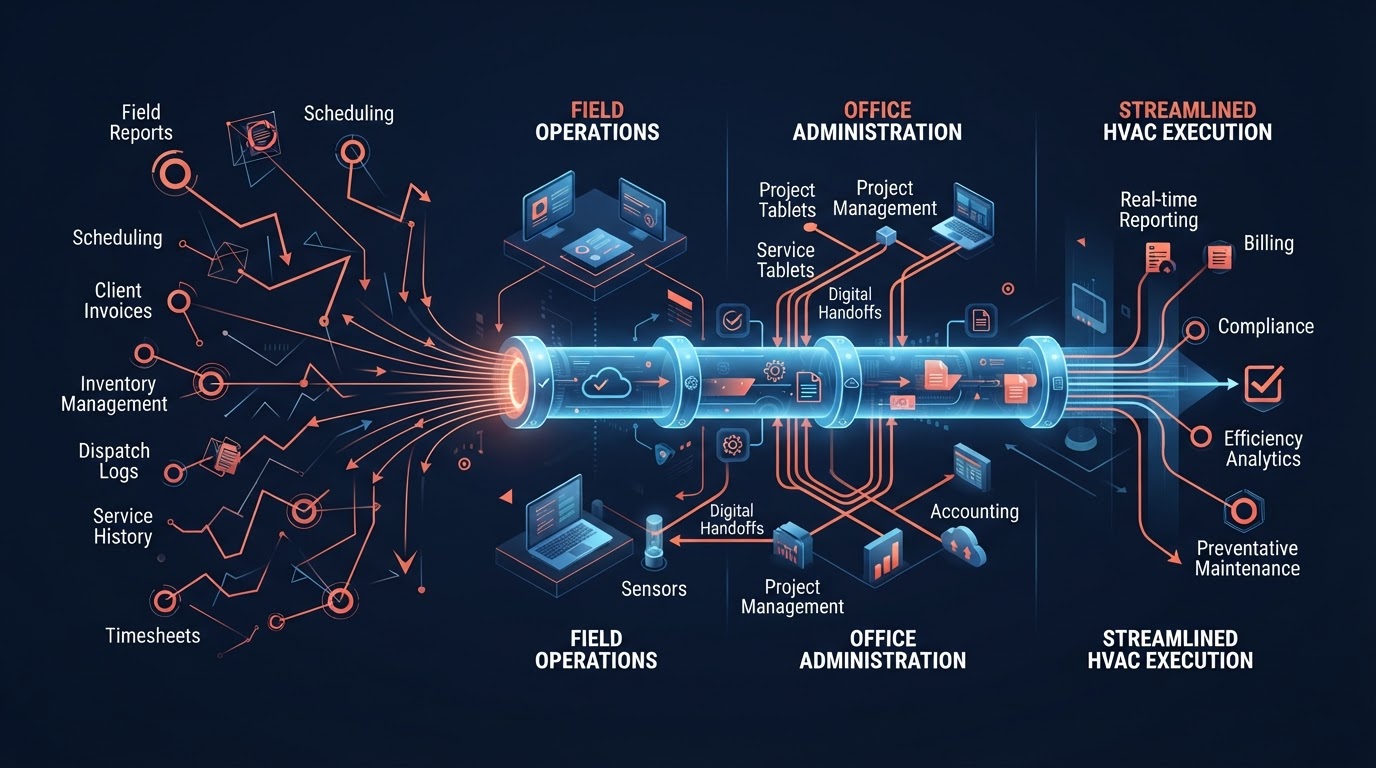
Poorly structured information — scattered across email, spreadsheets, paper notes and disconnected systems — limits what AI can do. Before investing in AI, assess whether your business information is:
Improving information quality is not glamorous, but it is one of the highest-value investments an HVAC business can make before AI adoption. For a practical framework, see our guide to improving job, asset and service information management.
Permissions and cyber security come before broad AI access
Before staff are given broad access to AI tools, the business should review identity, MFA coverage, least-privilege access, Microsoft 365 permissions, field and mobile device security, shared accounts, external sharing settings, departed staff access and application access. For businesses also looking to reduce administrative overhead, strengthening these foundations supports both security and workflow efficiency.
AI tools can make information easier to discover. If permissions are excessive or poorly governed, AI may surface information more broadly than intended. Strengthening security before AI deployment is a prerequisite, not an afterthought.
For a deeper treatment of cyber security for HVAC and mechanical services businesses, explore our Cyber Security Services and Essential Eight pages.
AI and field-service systems
AI may complement — rather than replace — the specialist systems an HVAC business relies on, including field-service management, job management, CRM, accounting, quoting, asset management, Microsoft 365 and specialist HVAC platforms.
The objective is not to replace working systems with AI, but to identify where AI can add value alongside existing platforms. This might include AI-assisted search across Microsoft 365, automated notifications between systems, or AI-assisted drafting within tools staff already use.
LOOKUP does not promote particular vendors. The right approach depends on your existing systems, integration capabilities, budget and business priorities.
Microsoft 365 and Copilot
Many HVAC businesses already own Microsoft 365, which includes platforms that can support AI readiness: Teams for communication, SharePoint for document collaboration, OneDrive for file storage, Outlook for email, and Power Automate for workflow automation.
Microsoft Copilot can assist with drafting communications, summarising meetings, searching information and automating tasks within Microsoft 365. According to official Microsoft documentation, Copilot works within a user's existing Microsoft 365 permissions — it does not grant access to information a user is not already authorised to see.
However, if permissions are broader than intended, Copilot may make information a user already has access to easier to discover. Reviewing permissions and governance before deployment is therefore important. Not all Copilot capabilities are available in every Microsoft 365 licence — check your current licensing before planning deployment.
Governance and human accountability
Responsible AI adoption requires governance. This means defining approved tools, approved use cases, rules for sensitive and customer information, review processes, escalation pathways, human responsibility for AI-generated content and staff training.
Staff know which AI tools are sanctioned for business use.
Clear guidance on what AI may and may not be used for.
What customer and business data should not be entered into public AI tools.
AI-generated content is reviewed before use. Humans remain accountable.
Staff know how to report concerns or unexpected AI outputs.
Employees understand how to use AI tools appropriately and safely.
What should not be handed blindly to AI
AI can assist with many tasks, but certain decisions should always involve human judgement:
AI can assist with these areas — for example, by drafting a quote or summarising a compliance document — but it should not become the accountable decision-maker.
60-SECOND AI GOVERNANCE CHECK
How Well Are You Governing AI?
Take LOOKUP's free 60-second check and see whether the basic governance foundations are in place before expanding AI use.
Free • Instant result • No details required
An HVAC AI readiness assessment
Before deploying AI, assess the business across these dimensions:
What business problem is AI meant to solve?
Are workflows consistent enough to support AI?
Is business information structured and accessible?
Can AI work alongside existing systems?
Are identity, access and devices secured?
Are policies and approved tools defined?
Are staff trained and ready for AI adoption?
Is there a clear, valuable use case to start with?
How this maps to the LOOKUP Business Modernisation Framework™
AI readiness for HVAC businesses follows the same structured methodology that guides every LOOKUP engagement. Learn more about the Business Modernisation Framework™.
Map current workflows, systems, information and AI use cases.
Review identity, MFA, permissions and field-device security.
Address legacy systems and improve Microsoft 365 foundations.
Create consistent processes for scheduling, dispatch and documentation.
Improve information quality, job data and workflow efficiency.
Establish governance, AI policies and approved use cases.
Deploy AI tools deliberately with training and human oversight.
Measure outcomes, review usage and continuously refine.
What success looks like
Successful AI readiness is measured by business outcomes, not technology deployment.
AI investment aligned to genuine business needs, not hype.
Cleaner job, asset and customer data supporting AI usefulness.
Standardised workflows ready for automation and AI assistance.
Approved tools, use cases and policies before broad deployment.
Controlled pilots with human review and clear escalation.
Fewer unmanaged tools and shadow AI usage across the business.
AI used where it adds measurable value, not everywhere.
Research and industry insights
The Australian Government has published voluntary AI Ethics Framework providing principles for responsible AI adoption. These principles — including fairness, transparency, accountability and privacy — are relevant to any Australian business exploring AI.
The Australian Cyber Security Centre provides guidance on baseline security controls that strengthen the foundations for responsible AI use, including identity protection, access control and patch management.
Microsoft's official documentation explains how Microsoft 365 Copilot works within existing user permissions, which is important for understanding AI information access in a business environment.
Microsoft's 2024 Work Trend Index examined how AI-assisted activities such as drafting, summarising and information retrieval can affect the way knowledge workers perform administrative and information-heavy tasks. This research is relevant to HVAC businesses considering AI for office and administrative functions.
What this could look like in practice
For example, a growing HVAC contractor might have accumulated increasing office administration, scheduling complexity across multiple technicians, customer information spread across email and a field-service platform, a Microsoft 365 environment that is not fully utilised, and growing interest in AI — but no agreed governance or approved tools.
A structured approach might involve:
Frequently asked questions
How can HVAC businesses use AI?
HVAC businesses can use AI to assist with customer enquiries, job triage, scheduling support, quote drafting, meeting summaries, knowledge search and administrative follow-up. AI should support — not replace — technical judgement, safety decisions and professional accountability.
What should an HVAC business do before adopting AI?
Before adopting AI, an HVAC business should understand its workflows, improve information quality, review cyber security, establish governance and identify genuine use cases. AI works best when the underlying business processes and information are well structured.
Can AI schedule HVAC technicians?
AI can assist with scheduling by suggesting optimal technician assignments based on skills, location, availability and job priority. However, final dispatch decisions involving safety, contractual commitments or complex customer requirements should remain with human coordinators.
Can AI help HVAC businesses prepare quotes?
AI can help draft quotes by pulling information from job details, service history and standard pricing. A human reviewer should verify technical accuracy, pricing and customer-specific requirements before any quote is sent.
Can AI answer customer enquiries?
AI can help draft responses to common customer enquiries, triage incoming requests and provide initial information. Sensitive customer commitments, technical advice and complaint handling should involve human staff.
Can AI reduce HVAC administration?
AI can help reduce repetitive administrative work such as follow-up emails, meeting summaries, task creation and internal notifications. This creates capacity for higher-value client service and technical work.
Can AI replace HVAC technicians?
No. AI can assist with information access, documentation and administrative tasks, but it cannot perform technical work, make safety decisions or replace the professional judgement of qualified technicians.
Can Microsoft Copilot help an HVAC business?
Microsoft Copilot can assist with drafting communications, summarising meetings, searching information and automating tasks within Microsoft 365. Its usefulness depends on information quality, permissions and governance. Copilot works within a user's existing Microsoft 365 permissions.
Does an HVAC business need clean data before using AI?
Yes. Poorly structured information — inconsistent customer records, incomplete service history or scattered job notes — limits AI usefulness. Improving information quality is a prerequisite for meaningful AI outcomes.
How does cyber security affect AI readiness?
Cyber security is a prerequisite for responsible AI adoption. Weak identity controls, shared accounts, poor MFA coverage and excessive permissions increase the risk that AI tools expose information inappropriately. Security should be strengthened before broad AI access.
Can AI use service history and asset information?
Yes. Well-structured service history, asset records and job notes can help AI provide useful summaries, search results and recommendations. If this information is incomplete or scattered across systems, AI assistance will be limited.
Should an HVAC business connect AI to its field-service system?
AI may complement field-service systems through approved integrations, but direct connections should be assessed carefully. Consider data sensitivity, permissions, vendor support and whether the integration adds genuine business value before connecting AI to operational systems.
What information should not be entered into public AI tools?
Sensitive customer information, pricing details, contractual terms, staff personal information and proprietary business data should not be entered into public AI tools without appropriate governance. Use approved, governed AI tools within your Microsoft 365 environment where possible.
Does an HVAC business need an AI policy?
An AI policy helps staff understand which tools are approved, what information may be used, what requires human review and how to report concerns. A simple policy reduces risk and supports responsible experimentation.
Where should an HVAC business start with AI?
Start by understanding your current workflows, information quality and security posture. Identify one or two high-value, low-risk use cases. Establish basic governance, pilot with a small group, measure the outcome and expand from there.
What business leaders should do next
Related resources and services
Structure operational information for better field work and AI readiness.
Bring AI, security, Microsoft 365 and automation into one coordinated plan.
Industry-specific technology guidance.
Strategic AI guidance for your business.
Prepare Microsoft 365 for Copilot.
Assess your readiness for AI adoption.
Build the foundations for AI.
Deploy AI with governance and oversight.
Automate repetitive workflows.
Optimise your Microsoft 365 environment.
Practical governance for responsible AI.
Prepare for successful Copilot adoption.
The eight-stage methodology.
Plan technology investment strategically.
Sources & Further Reading
Australian Government guidance on baseline cyber security controls relevant to AI readiness.
View SourceOfficial documentation on how Copilot works within Microsoft 365 permissions and environments.
View SourceGuidance on privacy obligations relevant to customer information handling and AI adoption.
View SourceVoluntary framework providing ethical principles for responsible AI adoption.
View SourceResearch examining how AI-assisted activities affect knowledge worker productivity.
View SourceComprehensive cyber security guidance including identity, access and information protection.
View SourceLOOKUP references recognised industry, government, professional and technology sources when discussing research, regulation and industry trends. Research findings are paraphrased and linked to their original sources wherever practical. LOOKUP's professional observations and recommendations are presented separately from third-party research.
This page provides general business technology information. AI use should be assessed against the organisation's operational, safety, privacy, contractual and regulatory responsibilities.
Prepare Your HVAC Business for AI with Confidence
LOOKUP helps HVAC and mechanical services businesses understand their workflows, improve information quality, strengthen security and build the governance foundations for responsible AI adoption. Explore our broader technology approach for HVAC & mechanical services businesses.