AI should help us build a better business
By Peter Kantarelis ·
I've been thinking about what we're actually improving when we put AI into a business.
We can get a reply written faster, prepare a proposal or summarise a meeting.
Those can be useful jobs.
But if we keep giving people the wrong information, making promises we can't deliver or passing incomplete work between departments, faster preparation won't fix the whole problem.
We may just get through more of the same mistakes.
That's where I think the bigger opportunity is for entrepreneurs and small business owners.
Working with AI can give us a practical reason to examine how our businesses work, and make that work easier to explain, deliver and improve.
The conversations are part of the improvement
In my own work, a conversation about getting something done often becomes a conversation about the process behind it.
What does the person doing the work need to know?
Where is that information, and who decides what's correct?
If an assistant keeps asking me the same question, sometimes the answer is still only in my head.
Sometimes the instructions are missing, two records disagree, or the person doing the work doesn't have access to what they need.
And sometimes the AI has simply misunderstood.
The useful step is working out which problem we're dealing with.
A correction in a chat helps with that moment.
If it reveals a recurring problem, I want the approved improvement recorded where the next person, and their assistant, can use it.
That means checking the lesson, updating the process and explaining the change to the people doing the work.
Otherwise, we're paying attention to the same problem again next week.
Different jobs need different kinds of help
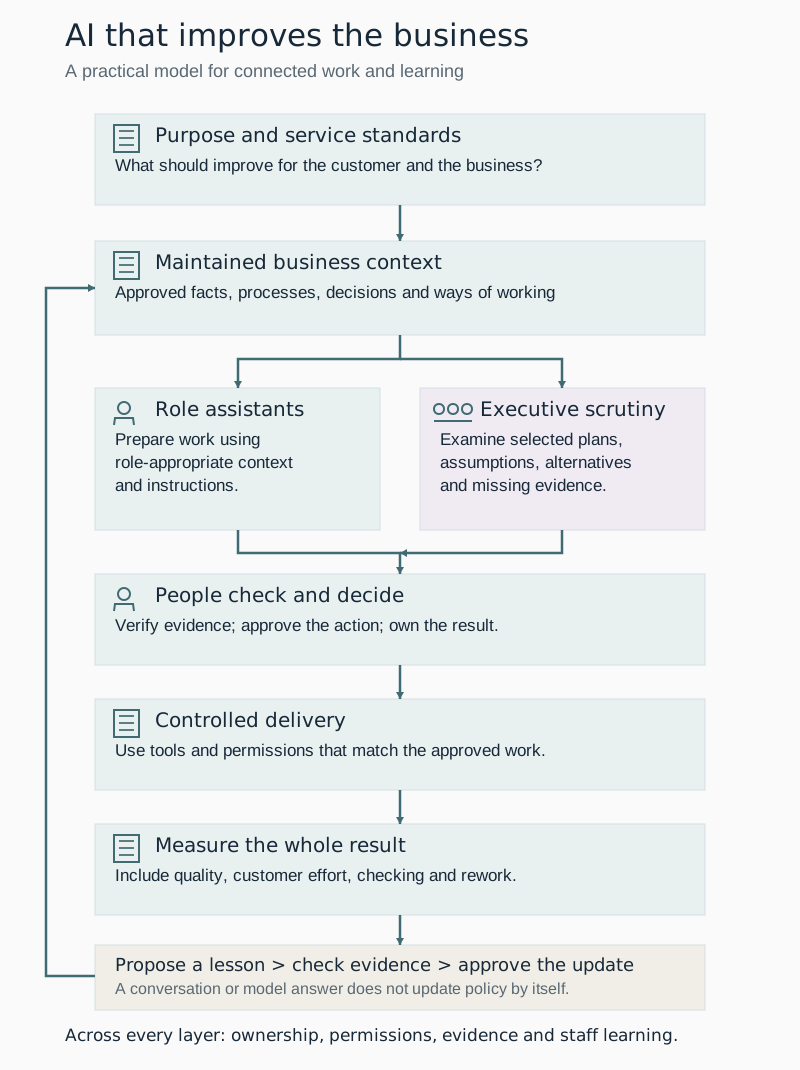
I think about organisational AI in layers, with a clear purpose running through them.
What are we trying to deliver for the customer, and what standard are we prepared to be accountable for?
That comes before choosing the software.
The shared business knowledge needs to include current facts, agreed processes and the decisions people are expected to follow.
Each important record needs an owner so someone is responsible for keeping it useful.
Shared doesn't mean everyone sees everything.
A person's assistant should have the information appropriate to their role, with private or sensitive material restricted.
Role-based assistants can then help people prepare work using that context.
Someone in sales needs different instructions from someone handling service delivery, even when they work in the same business.
Connections to business systems add another responsibility.
Finding a record, drafting a change and actually changing it are different actions.
The permissions in the software need to reflect what we've authorised.
An ordinary calculation or a required-field check may be better handled by existing software than by asking AI to work it out each time.
For important plans and decisions, there is also a place for executive scrutiny.
We can ask AI to examine a proposal from a finance, operations or customer perspective, identify assumptions and suggest what evidence would change the recommendation.
Those perspectives are prompts for better examination.
Several AI roles agreeing with each other doesn't make the answer independently verified, and disagreement isn't proof of insight either.
People still need to check the evidence, decide what to do and take responsibility for the result.
Take a customer handover
Here's a hypothetical example.
A service business wants to reply to customers more quickly.
It adds AI to prepare acknowledgements, and the replies become quicker.
The delivery team still receives incomplete information, so jobs come back to sales and customers repeat what they've already explained.
The reply was only one part of the problem.
Working through the handover reveals that nobody has agreed which information is required before a job can be accepted.
The team defines that information, records who can approve an exception and makes the current requirements available to the right people.
A sales assistant can help prepare the handover and point out missing information.
The system can check required fields, while a person approves any exception.
An operations review might challenge whether the new requirements create unnecessary work for simple jobs.
A customer review might ask whether we're collecting information already supplied somewhere else.
The owner can test a revised handover, then examine the complete result: checking time, returned jobs, customer effort and delivery quality.
If it works, the process owner updates the instructions and teaches the change.
This example doesn't establish a saving or a customer outcome.
It shows the sort of improvement I'd want to investigate before deciding that the next AI tool is the answer.
Business knowledge needs deliberate maintenance
A folder full of conversations isn't automatically a reliable company brain.
Conversations contain unfinished thinking, mistakes and information that may no longer be current.
I'd want a proposed lesson separated from an approved instruction, with a source, an owner and a date.
The people using it also need a way to report when it no longer fits the work.
That is how an individual correction can become something the business learns from.
It isn't the same as the underlying AI model learning permanently from every conversation.
General AI tools can use information we provide and, where configured, connected business records.
What they retain or use for model training depends on the product, its settings and its terms.[1][2]
We still have to decide what belongs in our business records and keep it maintained.
Strategy needs the same discipline
The same approach applies when we're considering a marketing plan, a service promise or a longer-term direction for the business.
For a quarterly plan, I'd want clear actions, owners and a date to examine the result.
For a five- or ten-year direction, I'd want different possible futures and the assumptions behind them, rather than a confident prediction.
AI can help us examine those questions and prepare alternatives.
It can't remove the need for evidence, experience and judgement.
Know when the extra layer is costing more than it helps
More assistants, more connections and more reviews can create work of their own.
If people spend more time correcting outputs, reconciling versions or passing work between tools, we need to count that.
A simple task shouldn't need an executive review just because one is available.
I'd compare the whole process before and after a change, including setup, checking, maintenance and the quality of what reaches the customer.
Keep what helps, simplify what doesn't, and give the people doing the work enough understanding to question the result.
An opportunity to raise our standards
I think this is a great time to be building a business.
Small teams have an opportunity to examine work that has been difficult to document, make decisions more explicit and help people deliver consistently.
Profitability and competitiveness matter.
So does the customer's experience of dealing with us, right across the organisation.
World-class delivery is a standard to work towards and demonstrate through results.
Which recurring problem in your business would be worth fixing properly before you ask AI to do more of it?
Reading notes
- OpenAI's API data controls explain that API inputs and outputs are not used for training by default unless the customer opts in. That policy does not describe every consumer product or eliminate data retention.
- Anthropic's commercial-product training policy distinguishes commercial offerings from consumer products and describes exceptions for explicit participation or feedback. Check the terms and settings of the actual service being used.